The State of Montgomery enters 1921 caught between two centuries. Explore the cities, communities, industries, and conflicts shaping the world your character will call home.
The State of Montgomery
1921
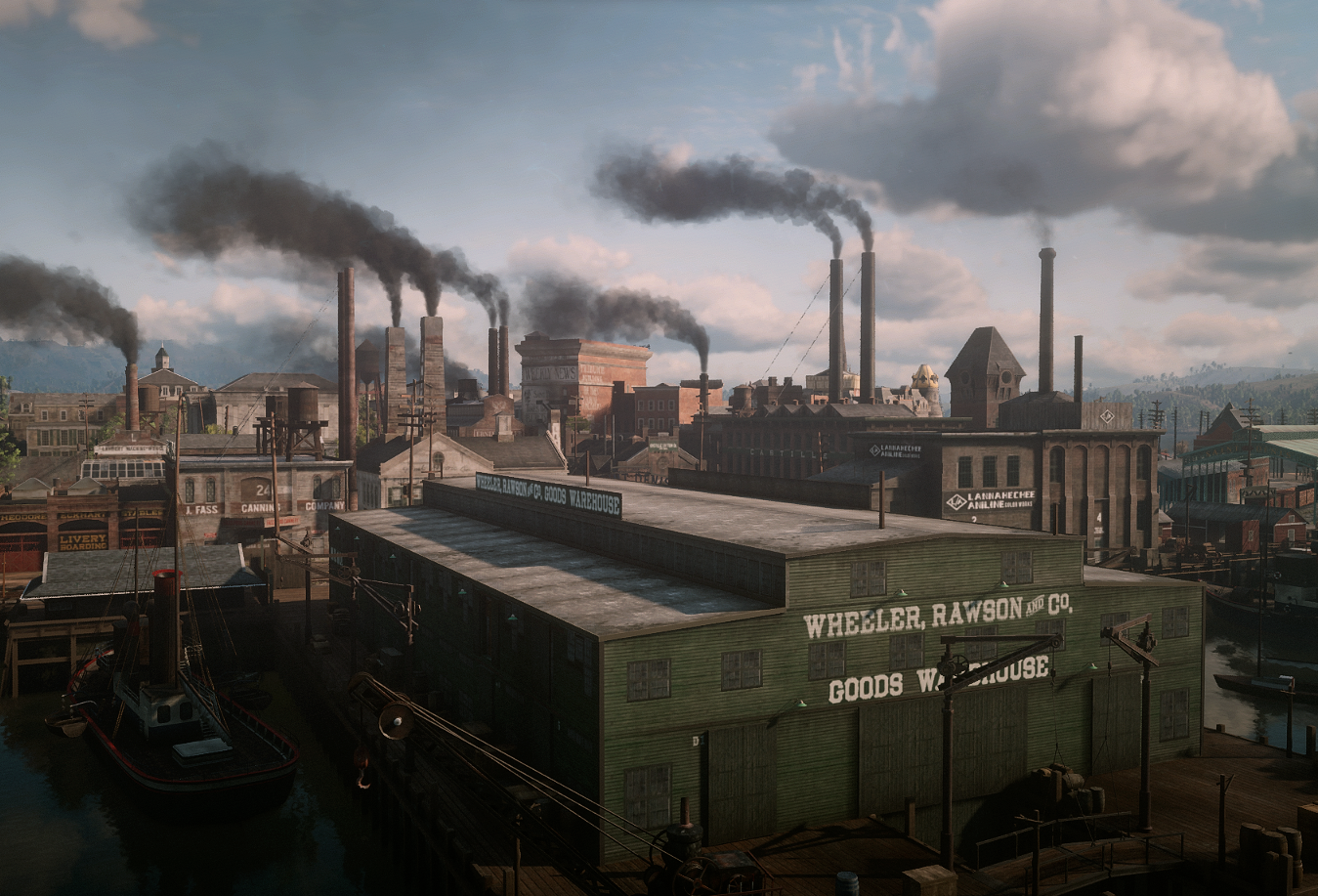
The State of Montgomery enters 1921 caught between two centuries. In Saint Denis, factories burn through coal day and night while automobiles compete with wagons along crowded streets and ships carry goods from across the world into its harbor. In Blackwater, government offices, banks, paved streets, and modern businesses represent the state's ambitions for the future. Yet only a few hours away, ranch hands still drive cattle into Valentine, lumber crews disappear for weeks into the forests of West Elizabeth, miners descend beneath Annesburg before sunrise, and isolated trappers in Ambarino live much as their fathers did decades earlier. The Great War is over, Prohibition has begun, and modernization is rapidly changing where Montgomery's money and power reside. Old families struggle to preserve influence built generations ago while industrialists, unions, politicians, immigrants, businessmen, criminals, and returning veterans compete for their place in the new order. Montgomery is wealthy, but much of its population is not. Its cities depend upon resources extracted by distant towns that see little of the prosperity they create. Railroads, farms, mines, ports, stockyards, and forests bind these different worlds together, while corruption and organized crime increasingly follow the same routes as legitimate commerce.
Saint Denis — The Capital
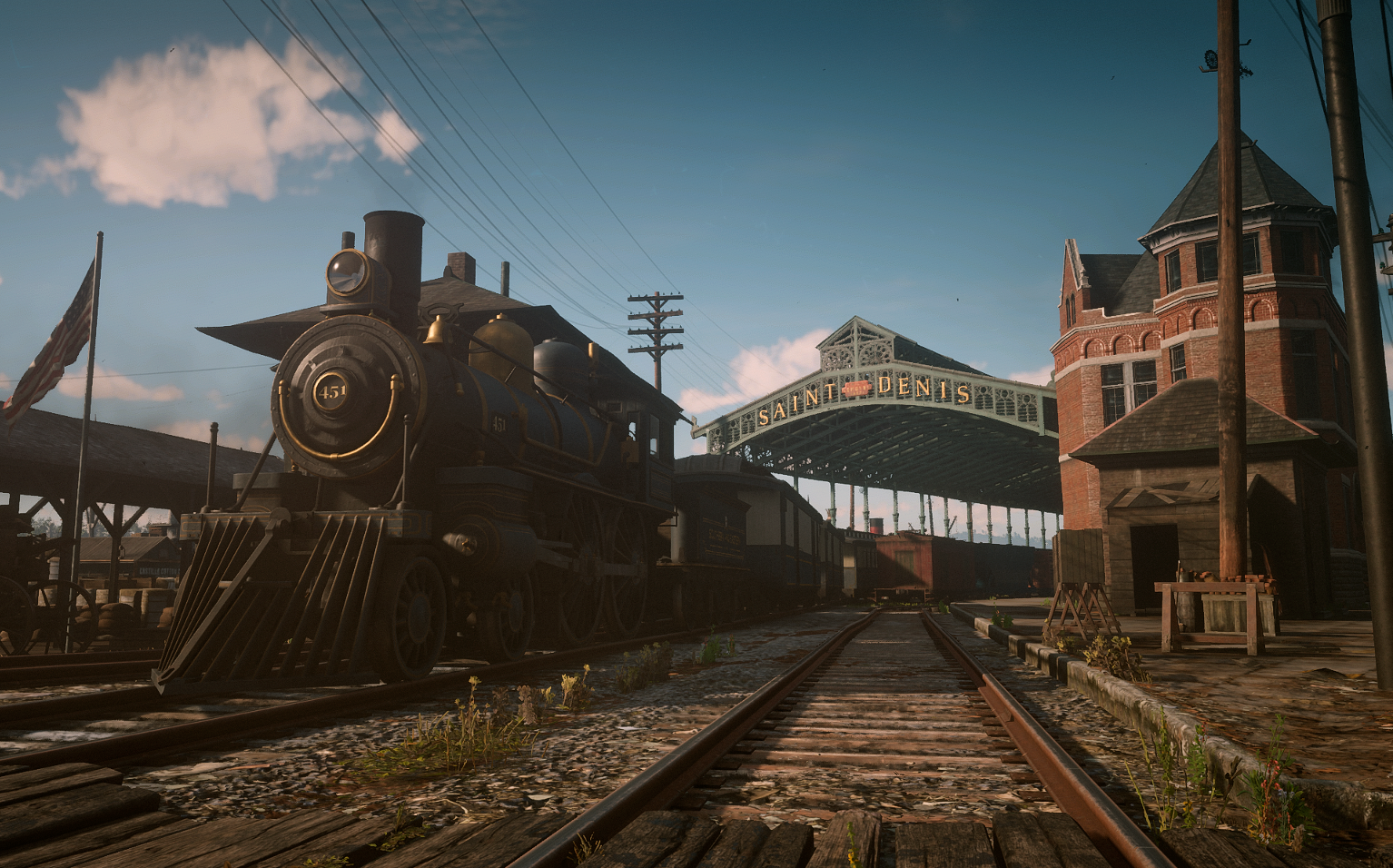
Saint Denis is the political, industrial, and commercial center of Montgomery. It is the state's largest city, its principal port, and the seat of the Government of the State of Montgomery.
Factories, warehouses, banks, rail yards, shipping companies, government offices, and crowded neighborhoods make Saint Denis unlike anywhere else in the state. Immigration has transformed portions of the city into communities built around shared language, religion, nationality, occupation, and neighborhood.
With that growth has come competition for political and economic power.
Among the Italian community, an emerging criminal organization commonly known as the Syndicate has established itself within the city's underworld. Its structure predates the more formal criminal organizations that may eventually follow it, operating instead through interconnected businessmen, criminals, neighborhood figures, and associates involved in various illegal enterprises.
Along the waterfront, the predominantly Irish Victory Street Ward has built its influence around dock labor and union politics. Control over longshoremen gives the Ward influence over who works the docks and, increasingly, what passes through them. Legitimate shipping companies, importers, exporters, and criminals alike may find themselves dealing with Ward representatives. Behind its political and labor activities are allegations of racketeering, liquor smuggling, and weapons trafficking.
Within portions of Saint Denis's Black community, the Franklin Street Club has emerged from the city's neighborhood and nightlife culture as another source of local influence. Gambling, entertainment, bootlegging, business interests, and neighborhood connections have allowed the organization to establish a place within the city's increasingly crowded underworld.
The Chinese community has developed institutions of its own, among them the Three Lantern Society, an organization whose influence extends through portions of the community's commercial and social life while carrying persistent connections to illicit enterprise.
None control Saint Denis outright.
Political officials, police, businessmen, unions, neighborhood organizations, and criminal interests constantly negotiate, cooperate, and compete with one another. Alliances formed over one shipment or election may mean little during the next.
In Saint Denis, power rarely belongs to whoever carries the biggest gun.
It belongs to whoever controls what people need.
Blackwater — The Modern City
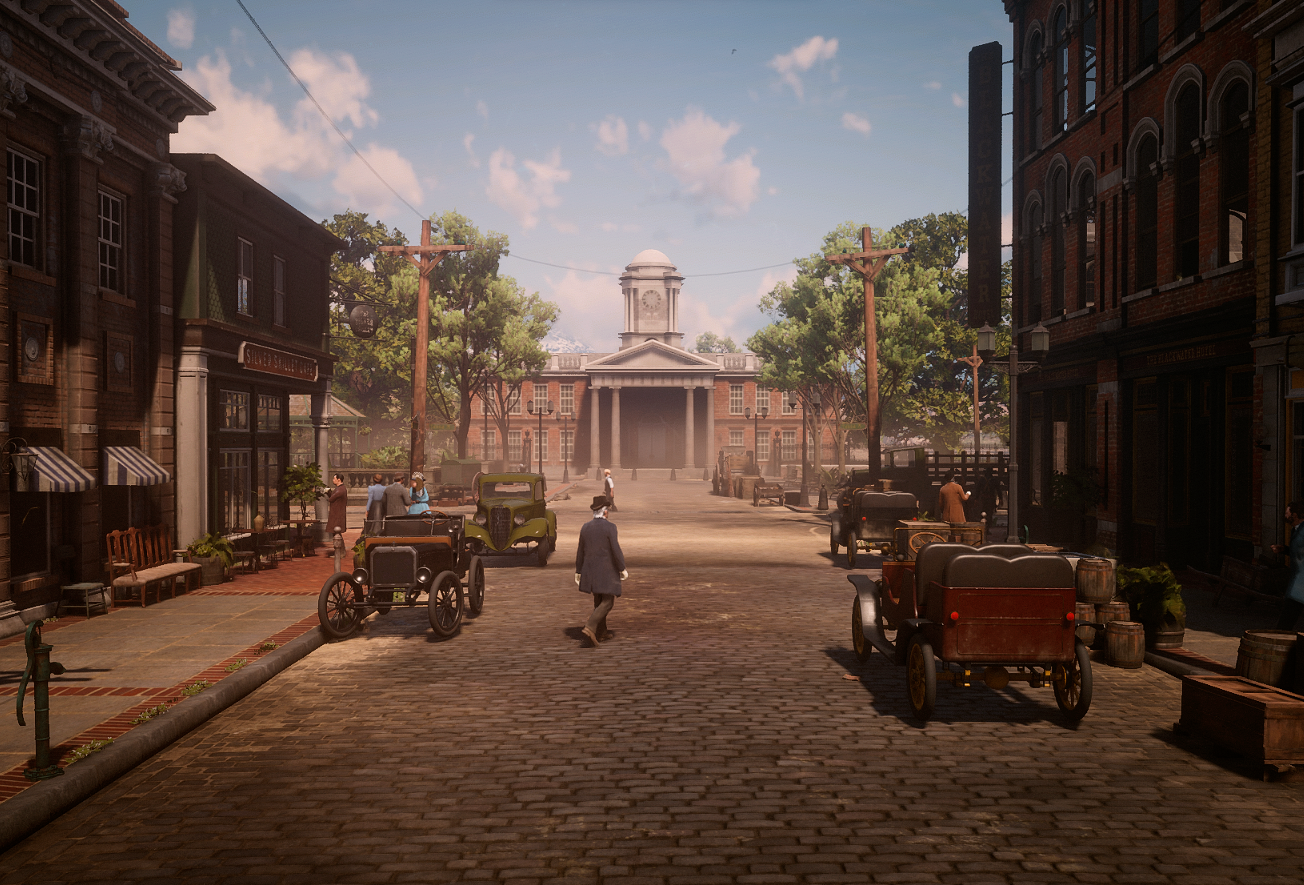
If Saint Denis represents what Montgomery has become, Blackwater represents what much of the state hopes it will become.
Modern businesses, automobiles, banks, government offices, and increasingly professional public institutions distinguish Blackwater from the rural communities surrounding it.
Its streets are considerably more controlled than those of Valentine or Strawberry. The Blackwater Police Department maintains a substantial presence, while state judicial authorities operate throughout the city. Blackwater also serves as an important center for federal Prohibition enforcement in Montgomery.
Organized criminal factions consequently maintain a considerably lower profile.
Blackwater's conflicts are more often found inside its institutions.
Political appointments, police investigations, business interests, prosecutions, elections, and government contracts provide opportunities for both legitimate influence and corruption. Honest officials work alongside careerists, political appointees, and men whose loyalties may extend beyond their office.
Outside the city, the situation becomes less certain.
The forests, roads, businesses, and smaller communities surrounding Blackwater have developed a reputation for involvement in the growing illegal liquor trade. Rumors connect legitimate businesses with bootlegging organizations operating elsewhere in Montgomery and beyond the state's borders, although whether these operations represent one organization or dozens of independent arrangements is rarely clear.
Blackwater presents itself as Montgomery's model of modern order.
What happens behind that appearance is considerably more complicated.
Rhodes — The Old Order
Rhodes sits uneasily between modern Montgomery and the rural South that preceded it.
The railroad, automobiles, and outside investment have brought pieces of the twentieth century into town, but the surrounding countryside remains dominated by cotton, tobacco, tenant farms, and enormous estates belonging to families whose names have carried influence for generations.
Many of these families trace their fortunes to the late eighteenth and early nineteenth centuries. During the decades before the Civil War, their ancestors accumulated large estates and immense agricultural wealth through a plantation economy built upon enslaved labor.
The Civil War marked the end of their greatest period of power.
Confederate defeat and emancipation dismantled the labor system upon which much of that wealth had depended. Fortunes collapsed, properties were mortgaged or divided, and families accustomed to considerable political authority found themselves fighting to preserve what remained.
The survivors adapted.
By 1921, cotton and tobacco remain central to the region, while some families have expanded into banking, timber, transportation, and other businesses. Large estates continue operating through hired workers, tenants, and sharecroppers. Others survive largely upon their family name while debts quietly consume what remains of their inheritance.
They are not attempting to recreate the society that existed before the war. What many seek instead is the political and economic dominance their families once possessed.
The courthouse has replaced the plantation house as the principal battlefield.
Elections, judgeships, sheriffs, bank loans, agricultural contracts, railroad agreements, land purchases, and county projects provide opportunities for competing families to increase their influence at another's expense. Bribery, patronage, political favors, and generations-old rivalries remain part of life around Rhodes.
The old families share an interest in preserving their place within Montgomery.
They rarely agree on which family deserves to stand above the others.
Valentine — The Agricultural Heartland
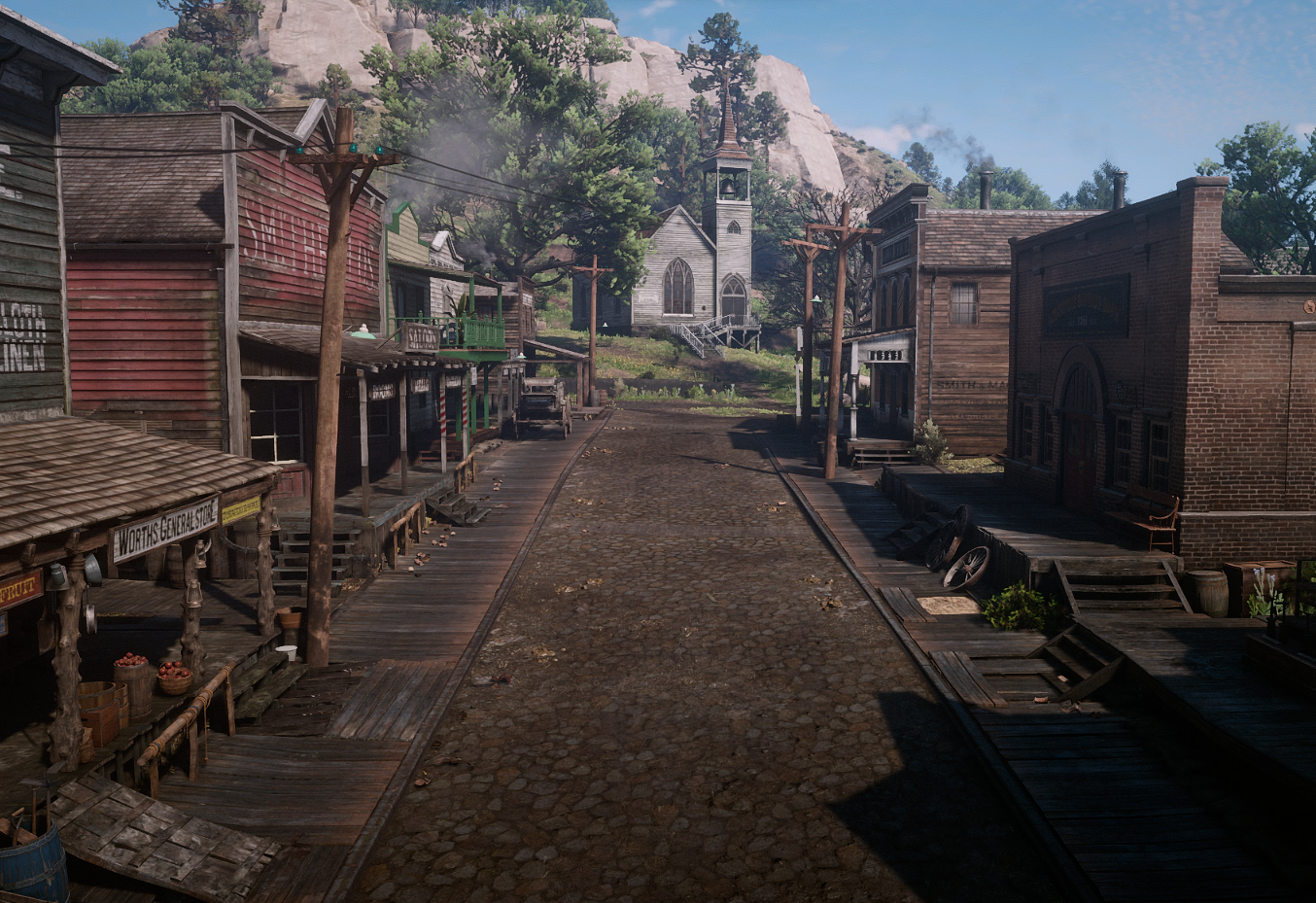
Valentine has never been wealthy, and by 1921 it shows.
Its infrastructure is aging, roads are poorly maintained, public services are limited, and reliable employment outside agriculture remains difficult to find. Ranch hands, slaughterhouse workers, farm laborers, livestock handlers, railroad workers, and temporary laborers form much of the local workforce.
Yet Montgomery cannot afford to ignore Valentine.
The surrounding countryside contains some of the state's most productive farms and ranches, including large operations such as Emerald Ranch. Cattle, sheep, hogs, horses, grain, and agricultural products flow toward Valentine before continuing elsewhere.
At the center of this economy stands Montgomery's largest livestock market and slaughtering industry.
Farmers and ranchers travel from across the state to buy and sell animals, arrange transportation, negotiate contracts, and hire workers. During major auctions, livestock and visitors can temporarily overwhelm the little town.
The money rarely stays long.
Animals purchased in Valentine are slaughtered and shipped elsewhere. Hides travel to manufacturers. Meat feeds growing cities. Agricultural profits increasingly flow toward banks, railroad companies, wholesalers, and businesses headquartered far beyond New Hanover.
Thin law enforcement throughout the surrounding countryside has also made the region attractive to criminals.
Rustling, horse theft, robbery, and livestock fraud remain persistent problems. Fugitives can find cheap lodging or temporary work, while criminals operating outside town may have miles of countryside between themselves and the nearest lawman.
Valentine lacks the money of Blackwater or the political influence of Rhodes.
But Montgomery has to eat.
Much of what feeds it passes through Valentine.
Strawberry & Western West Elizabeth
Strawberry once imagined a different future for itself.
Mountain scenery, forests, rivers, hunting, and clean air once attracted visitors looking to escape Montgomery's growing cities. Hotels, guides, merchants, and outfitters developed around a modest tourism industry.
By 1921, much of that prosperity has faded.
Strawberry is considerably poorer than the major cities of Montgomery, and increasingly the town survives from the wilderness surrounding it.
Logging crews work throughout West Elizabeth. Commercial hunters and trappers supply meat, hides, and pelts. Sawmills, teamsters, guides, freight companies, and laborers support industries whose products ultimately travel across Montgomery.
Like Valentine, Strawberry sees surprisingly little of the wealth it creates.
The wilderness has also become useful for another industry.
Prohibition transformed the forests and mountain roads of West Elizabeth into natural corridors for liquor trafficking. Logging roads, hunting trails, isolated cabins, and legitimate freight operations provide smugglers with countless opportunities to move or conceal contraband.
Highway robbery remains another persistent danger. Freight shipments, automobiles, payrolls, hunters, and travelers become increasingly vulnerable as they move farther from populated areas.
Some criminals are independent highwaymen or desperate locals. Others appear organized enough to suggest connections with larger operations in Blackwater, Saint Denis, or outside Montgomery.
Strawberry remains small and frequently overlooked.
The resources moving through the surrounding forests ensure it is never unimportant.
Annesburg — Coal Country
Annesburg is little more than a narrow industrial town built around one resource.
Coal.
Its mines contain some of Montgomery's richest coal deposits, supplying fuel for factories, furnaces, businesses, and the locomotives connecting the state.
At the center of nearly everything stands the Jameson Mining and Coal Company.
Jameson employs hundreds of miners, mechanics, engineers, railroad workers, and laborers. Merchants depend upon miners' wages, freight operators depend upon company shipments, and families throughout Roanoke Ridge depend directly or indirectly upon the mines.
When Jameson works, Annesburg works.
When the mines stop, the consequences can reach Saint Denis.
Dangerous conditions underground have also produced a powerful labor movement. Mining accidents, occupational illness, long hours, and disputes over wages have repeatedly placed workers against company management.
The mining union consequently possesses one weapon capable of threatening interests far beyond Annesburg: stopping production.
A sufficiently large strike can disrupt railroad schedules and industrial production throughout Montgomery.
That leverage has made union politics inseparable from local government.
Union leaders, company representatives, politicians, police, judges, and businessmen compete for influence in a town where almost everyone's livelihood ultimately returns to the mines. Political firings, bribery, intimidation, strikebreaking, sabotage, and threats of walkouts have become familiar parts of Annesburg's labor disputes.
Occasionally those disputes become violent.
Picket lines become fights. Organizers disappear. Company property burns. Strikebreakers are attacked. Workers die under circumstances officially declared accidents while their families insist otherwise.
Investigations have a habit of ending quietly.
Jameson needs miners.
The miners need Jameson.
And Montgomery needs coal.
That dependency ensures that the political battles of one dirty mining town can become problems for the entire state.
Van Horn
Whatever importance Van Horn once possessed has largely disappeared.
The old trading settlement has deteriorated into a collection of abandoned and aging structures along the eastern coast. Permanent commerce is minimal and government presence nearly nonexistent.
Its isolation has consequently made it useful to others.
Outlaw gangs, fugitives, smugglers, and bootleggers periodically occupy portions of the settlement as temporary hideouts or meeting places. No single organization permanently controls Van Horn, and few legitimate authorities consider maintaining a presence there worth the expense.
Van Horn is no longer truly a town.
It is simply a place where people go when they do not want to be found.
Colter & Ambarino — The Forgotten North
There was once money in the mountains.
During the nineteenth century, gold discoveries and the fur trade drew prospectors, trappers, merchants, and laborers into Ambarino. Settlements such as Colter emerged to support people searching for fortunes throughout the northern wilderness.
Those days ended long ago.
The richest claims were exhausted or abandoned. The great fur trade declined. Prospectors moved elsewhere, settlements emptied, and the population of Ambarino collapsed.
By 1921, it is Montgomery's forgotten frontier.
Small hunting companies continue operating in the mountains. Independent trappers work remote country for valuable pelts. Fishermen make their living from rivers and mountain lakes. Guides and occasional prospectors still search for opportunities where larger industries have disappeared.
Nobody becomes particularly wealthy.
They survive.
Government presence is almost nonexistent across large portions of the region. The population is too small, the territory too large, and the weather too severe to justify the law-enforcement presence found elsewhere in Montgomery.
Bootleggers have noticed.
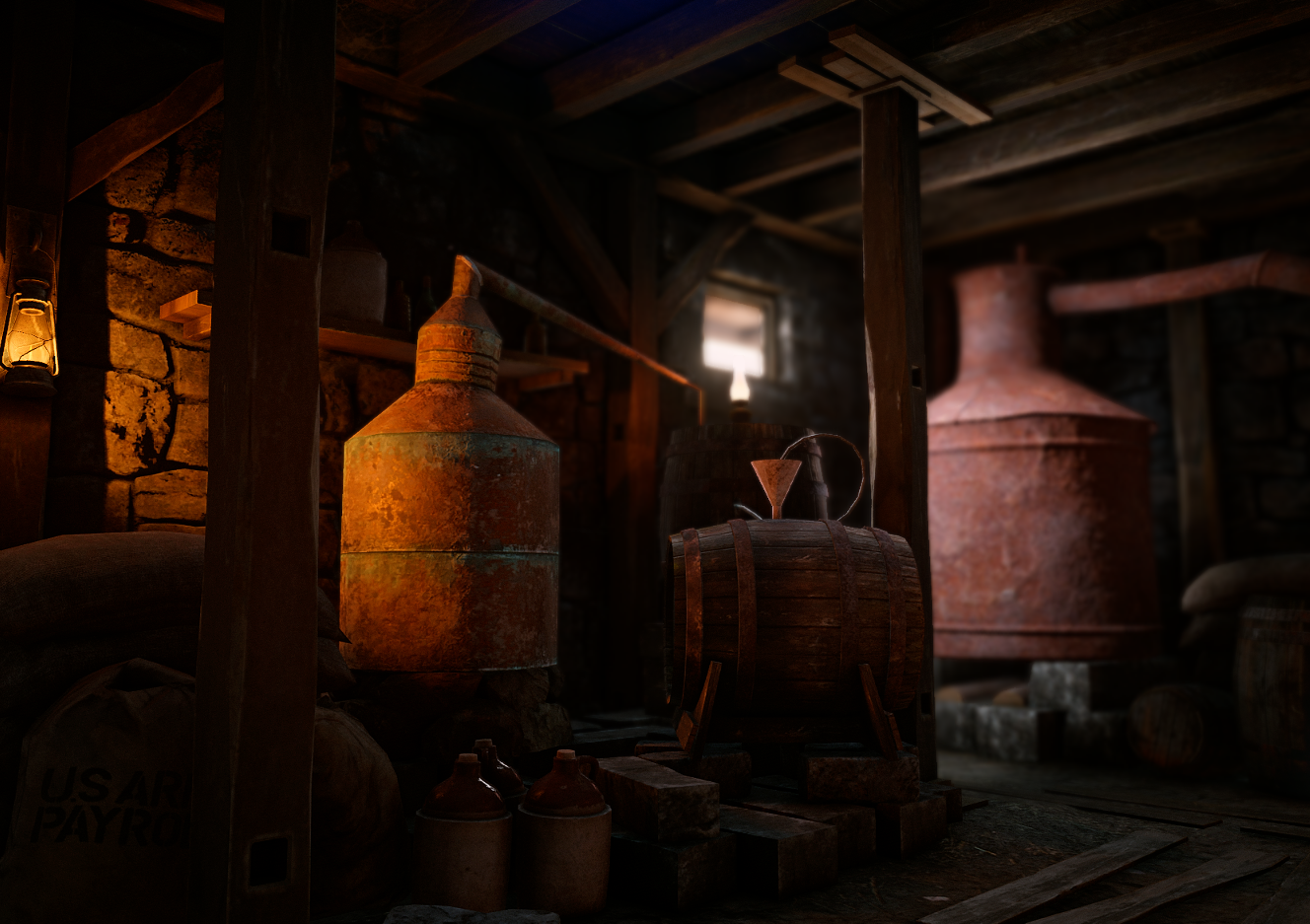
Remote cabins, abandoned mines, mountain trails, and forgotten settlements provide excellent locations for stills and hidden shipments. Criminals occasionally travel north believing the absence of law makes Ambarino safe territory.
The mountains frequently prove otherwise.
Outsiders underestimate sudden weather, deep snow, distance, lack of supplies, and the isolation between settlements. Every winter, men enter the mountains believing their greatest concern will be avoiding lawmen.
Some never come back.
The hunters, trappers, fishermen, and families who remain understand something outsiders often do not.
In Ambarino, surviving the country comes before making money from it.
Gold gave way to abandoned mines. The fur boom gave way to small trapping outfits. Settlements became empty buildings slowly disappearing beneath snow.
The rest of Montgomery moved into the twentieth century.
Ambarino was simply left behind.
Montgomery in 1921 is therefore not one world but several tied together by commerce. Saint Denis needs Annesburg's coal, Valentine's livestock, West Elizabeth's timber and Ambarino's remaining natural resources. Valentine and Rhodes need the railroads and urban markets. Blackwater's institutions attempt to impose modern government upon regions where state authority may barely exist.
The same connections carry something else.
Coal cars can conceal contraband. Freight companies can move liquor. Dockworkers can make cargo disappear. Politicians can protect businessmen. Rural roads can bypass federal agents. Money earned through crime in one county can be cleaned through legitimate enterprise in another.
Prohibition has not created Montgomery's corruption, poverty, political machines, labor conflicts, or organized crime.
It has simply given all of them a new business to fight over.